

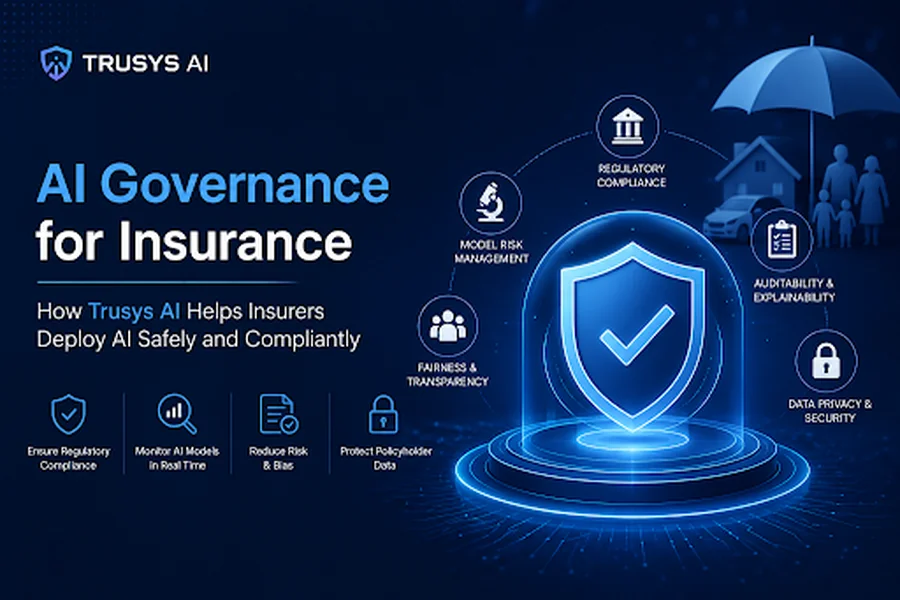
Insurers are adopting AI faster than most other regulated industries — across underwriting, claims processing, pricing, fraud detection, customer service, document processing, risk assessment, AI copilots, and increasingly autonomous, agentic workflows. AI governance for insurance is the set of processes, controls, policies, and technologies used to evaluate, monitor, secure, and manage AI systems throughout their lifecycle.
That adoption creates real efficiency and competitive advantage, but it also introduces risk that doesn’t show up in a traditional IT audit: bias, explainability gaps, hallucinations, privacy exposure, security vulnerabilities, model drift, regulatory noncompliance, unauthorized AI behavior, and dependency on third-party foundation models an insurer doesn’t fully control.
Why AI Governance Matters for Insurance
Insurance is a high-stakes environment for AI governance for a few structural reasons. AI systems increasingly make or heavily influence decisions with direct financial consequences for real people — what someone pays for coverage, whether a claim gets approved, whether an application is flagged as fraud. Those decisions run on sensitive customer data, sit under active regulatory scrutiny, and carry fairness and discrimination implications that regulators and courts take seriously.
Two more recent shifts raise the stakes further. Generative AI — copilots, chat-based assistants, document-drafting tools — introduces failure modes like hallucination and prompt injection that traditional predictive models never had. And AI agents that can call tools, retrieve data, and take multi-step actions introduce a new category of risk: unauthorized or unintended action, not just an inaccurate prediction.
A weak governance framework doesn’t just create compliance exposure. It creates operational risk (systems behaving unpredictably), financial risk (bad decisions at scale), reputational risk (public fairness failures), and security risk (AI systems as a new attack surface) — all at once, and often before anyone notices.
Where AI Governance Risks Appear Across the Insurance Lifecycle
The specific risk — and the governance control that addresses it — looks different depending on where in the insurance workflow the AI system sits:
Why Traditional Model Risk Management Is Not Enough
Most insurers already have some form of model risk management (MRM). It’s a mature discipline built around model validation, performance testing, documentation, a model inventory, and periodic review cycles — and it remains necessary. The problem is that it was designed for a narrower category of system than what insurers are deploying today.
Traditional MRM assumes a model with relatively stable behavior between review cycles. Generative AI, LLM-based copilots, AI agents, and third-party foundation models don’t behave that way. Prompts change. Tools get added. Underlying models get updated by the vendor without the insurer’s involvement. Outputs are generated in real time and can vary from one interaction to the next. A model that passed validation in Q1 can behave differently by Q3 without a single line of code changing on the insurer’s side.
That’s the gap between traditional model governance and modern AI governance: insurers need lifecycle and runtime governance — coverage that extends into production, continuously — not only pre-deployment model validation.
What a Modern AI Governance Framework for Insurance Should Include
AI Discovery and Inventory
Governance starts with knowing what AI systems actually exist: where they’re deployed, who owns them, what data they access, what models sit underneath them, and what decisions they influence. Insurers routinely underestimate this — AI adopted informally by individual teams (“shadow AI”) is common, and it’s difficult to govern a system compliance doesn’t know exists.
AI Evaluation and Risk Assessment
Before deployment, AI systems should be evaluated for accuracy, bias, safety, security, privacy, compliance, and robustness — ideally against standardized, repeatable tests rather than one-off manual review, so results are comparable across systems and over time.
Runtime AI Governance
Production AI needs continuous monitoring, not just a pre-launch check. That means visibility into real-time behavior, policy violations, unsafe outputs, hallucinations, data leakage, prompt-based attacks, unauthorized actions, and model drift as it happens — with the ability to intervene, not just log the event after the fact.
Continuous Monitoring and Assurance
Periodic audits alone are structurally insufficient for AI that updates, drifts, and interacts with changing tools and data on an ongoing basis. Continuous visibility is what lets an insurer catch a problem in days instead of finding it in next year’s audit.
Regulatory and Policy Alignment
Governance should map each AI system to the internal policies, risk controls, and regulatory requirements that apply to it. Requirements here vary by jurisdiction and are evolving — the NAIC’s Model Bulletin on the Use of Artificial Intelligence Systems, the EU AI Act’s high-risk classification for insurance underwriting and pricing, and comparable frameworks in other markets are all active areas insurers should track directly with legal and compliance counsel rather than relying on general summaries. This article is not legal advice.
How Trusys AI Helps Insurers Govern AI Across the Lifecycle
Trusys is built as a lifecycle assurance layer for AI: it evaluates systems before they ship, enforces policy while they run, and keeps watching after deployment — rather than treating governance as a single pre-launch checkpoint.
TruEval
TruEval evaluates AI systems — including agentic workflows — before and during deployment, covering tool use, multi-turn reasoning, and behavior across scoring metrics designed for regulated, high-stakes use cases. For an insurer, that means an underwriting or claims model can be tested against safety, security, compliance, and performance requirements before it ever touches a live policyholder decision.
TruGuard
TruGuard enforces policy at runtime — the inline layer that can block a disallowed output, redact sensitive data, or stop an out-of-policy action before it reaches a customer or a downstream system, rather than only flagging it after the fact.
TruPulse
TruPulse provides continuous visibility into AI systems in production — tracing what a system did, what data it touched, and what it produced. For insurers, that traceability is what turns “we think the model is behaving” into documented, audit-ready evidence.
TruScout
TruScout is Trusys’s adversarial testing layer — red-teaming AI systems against real attack techniques (prompt injection, jailbreak attempts, manipulation tactics) before those techniques get used against a production system handling policyholder data.
Argus sits above all four as the orchestration layer — running continuous evaluation through TruEval, watching production behavior through TruPulse, executing adversarial testing through TruScout, and enforcing policy through TruGuard, so governance operates continuously rather than as a series of disconnected point-in-time exercises. As with any platform capability, insurers evaluating Trusys should confirm current feature scope directly, since platform capabilities evolve.
A Practical AI Governance Framework for Insurers
A simple way to structure this: Discover → Evaluate → Govern → Monitor → Improve.
Discover means building and maintaining a real inventory of AI systems, owners, and data access — including systems adopted outside a formal procurement process. Evaluate means testing each system against accuracy, bias, safety, security, and compliance requirements before it goes live. Govern means setting and enforcing policy — what the system is and isn’t allowed to do — as a runtime control, not just a document. Monitor means continuous visibility into production behavior, not periodic sampling. Improve means using what monitoring surfaces to retrain, retune, re-scope, or roll back a system, then feeding that back into evaluation.
Applied to an AI-powered underwriting system, that means evaluating for bias before launch, enforcing pricing-fairness policy at runtime, and continuously monitoring for drift as risk pools shift. Applied to a claims automation workflow, it means human oversight built into the workflow itself, continuous monitoring for incorrect-decision rates, and an audit trail for every automated determination. Applied to an insurance AI agent, it means runtime governance over what tools the agent can call and what actions it can take unsupervised.
Key Questions Insurers Should Ask Before Deploying AI
-
What AI systems are currently operating in our organization?
-
What business decisions does each system influence?
-
What customer or sensitive data does it access?
-
Has the AI been evaluated for bias and security?
-
How are AI outputs monitored after deployment?
-
What happens when an AI system violates policy?
-
Can AI behavior be monitored in real time?
-
How are third-party AI models governed?
-
How are AI agents controlled?
-
Can the organization demonstrate an audit trail?
-
Who is accountable for each AI system?
The Business Value of AI Governance for Insurance Companies
Governance is often framed as compliance overhead, but for insurers it functions closer to infrastructure. Effective AI governance reduces AI-related risk before it becomes an incident, improves regulatory readiness so exams and audits move faster, and increases internal and customer trust in AI-driven decisions. It also has a direct operational payoff: problems get detected earlier, sensitive data is better protected, and leadership gets real visibility into what AI systems are actually doing — which is what lets an insurer scale AI adoption with confidence instead of hesitation. Strong governance also clarifies accountability, so when something does go wrong, the organization can show who owned the decision and why, rather than reconstructing it after the fact.
Why Trusys AI for Insurance AI Governance
Insurers evaluating an AI governance platform are generally weighing the same core capabilities: AI discovery, pre-deployment evaluation, runtime governance, continuous monitoring, AI risk visibility, policy enforcement, and lifecycle coverage rather than point-in-time checks. Trusys is built around exactly that set of capabilities, with Argus coordinating evaluation, monitoring, adversarial testing, and policy enforcement as one continuous process rather than four separate tools an insurer has to stitch together manually.
No governance platform makes AI risk-free, and Trusys doesn’t claim to. What it’s built to do is give insurers the visibility and controls to catch problems early, demonstrate accountability, and deploy AI with a defensible answer to “how do you know it’s behaving?” Insurers exploring an AI governance platform for underwriting, claims, or agentic workflows can look at Trusys AI’s AI Governance for Insurance solution to see how the lifecycle approach applies to their specific use cases.
Conclusion
Insurers moving AI beyond pilot programs are finding that fragmented controls — a validation step here, a compliance review there — don’t hold up against systems that update, drift, and act in real time. Responsible AI deployment is not a one-time model validation exercise. It requires continuous visibility, evaluation, governance, and monitoring across the AI system’s full lifecycle.
For insurers building that kind of AI governance program, Trusys AI offers a lifecycle approach built for exactly this shift — from pre-deployment evaluation through runtime enforcement and continuous monitoring. Book a demo to see how it applies to your underwriting, claims, or agentic AI workflows.