

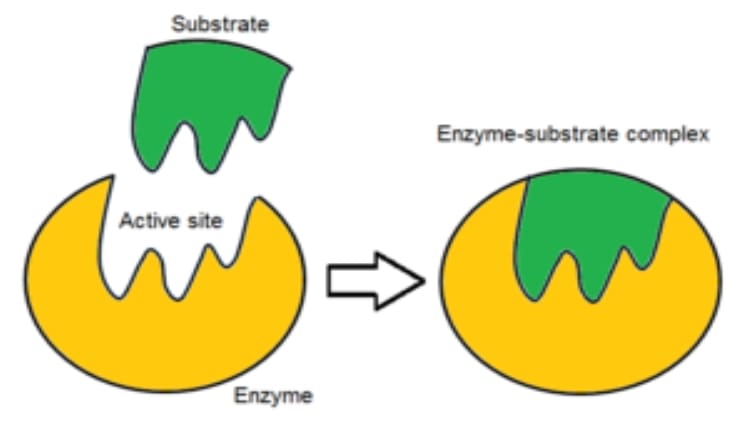
Enzymes are biological catalysts that are responsible for speeding up chemical reactions within cells. To do this, they must first bind with a substrate, a molecule that is used as a starting point for a specific reaction. Knowing where and how substrates bind with enzymes can help us better understand the role of enzymes in our bodies and how we can manipulate them for our own purposes.
Substrate Binding Sites
Substrates bind to enzymes at a specific area known as the active site. This site is where the substrate and enzyme interact to form a complex molecule. The active site is composed of amino acid residues that are arranged in a specific way to create a pocket or cleft that is the perfect size and shape for the substrate to fit into. This substrate-enzyme complex is then used to catalyze the reaction.
The active site of an enzyme is highly specific, meaning that only a certain type of substrate can fit into the pocket. This specificity is determined by the shape of the active site and the type of amino acid residues that make up the pocket. Each enzyme has a unique active site that is designed to bind with the specific substrate that it needs to catalyze its reaction.
How Enzymes Bind Substrates
Enzymes bind to substrates through a process called induced fit. This is when the enzyme undergoes a conformational change when the substrate binds to its active site. This change in shape helps to ensure that the substrate binds tightly to the enzyme and that the reaction takes place efficiently.
The induced fit model also explains how enzymes can bind to multiple substrates. When the enzyme binds to one substrate, its shape changes slightly to accommodate the substrate. This change in shape also makes it easier for the enzyme to bind to other substrates, as the active site is now slightly different.
In summary, substrates bind to enzymes at the active site. This site is composed of amino acid residues that are arranged in a specific way to create a pocket or cleft that is the perfect size and shape for the substrate to fit into. The binding process is facilitated by induced fit, where the enzyme undergoes a conformational change when the substrate binds to its active site. Understanding how and where substrates bind with enzymes can help us better understand the role of enzymes in our bodies and how we can manipulate them for our own purposes.