

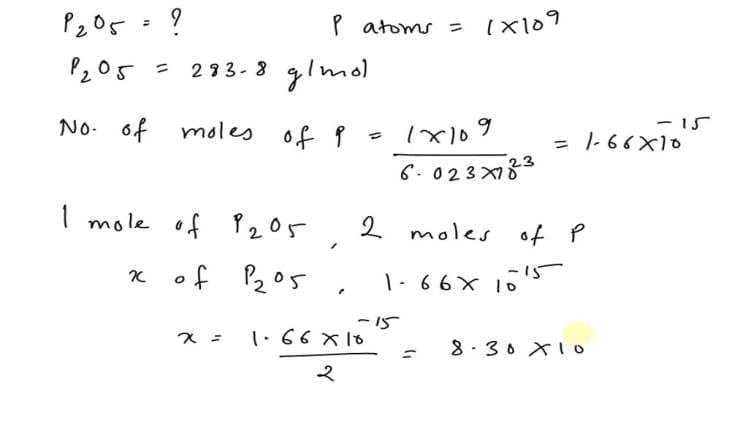
Diphosphorus pentoxide (also known as P2O5) is an inorganic compound that is used in a variety of industrial and laboratory applications. It is a white solid which is composed of two phosphorus atoms and five oxygen atoms. The compound has a molar mass which is used to measure the amount of the compound in a given sample. In this article, we will explore what the molar mass of diphosphorus pentoxide is and how it is calculated.
What is Diphosphorus Pentoxide?
Diphosphorus pentoxide is a white solid that is composed of two phosphorus atoms and five oxygen atoms. It is an inorganic compound which is used in a variety of industrial and laboratory applications. It is also known as phosphorus pentoxide and is often found in the form of a powder. It is an important chemical in the manufacture of various fertilizers, pesticides, and other compounds.
What is the Molar Mass of Diphosphorus Pentoxide?
The molar mass of diphosphorus pentoxide is 141.964 g/mol. This value is calculated by taking the atomic masses of the two phosphorus atoms and the five oxygen atoms and adding them up. The atomic mass of phosphorus is 30.973762 and the atomic mass of oxygen is 15.9994. Therefore, the molar mass of diphosphorus pentoxide is calculated by adding up the atomic masses of the two phosphorus atoms (30.973762 x 2 = 61.947 g/mol) and the five oxygen atoms (15.9994 x 5 = 79.997 g/mol) to get a total of 141.964 g/mol.
In conclusion, diphosphorus pentoxide is an inorganic compound which is composed of two phosphorus atoms and five oxygen atoms. The molar mass of diphosphorus pentoxide is 141.964 g/mol which is calculated by adding up the atomic masses of the two phosphorus atoms and the five oxygen atoms. This value is important in order to measure the amount of the compound in a given sample.