

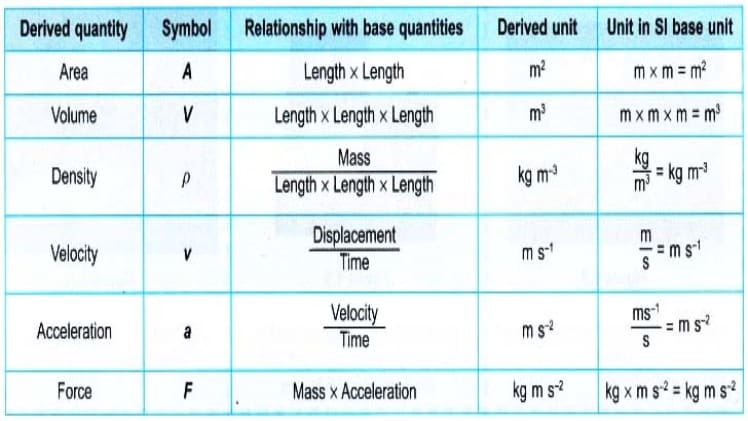
Derived quantities are an important concept in physics and science. They are used to measure physical properties, like velocity, acceleration, and pressure. In this article, we will discuss what derived quantities are and their properties.
Definition of Derived Quantity
Derived quantities are physical quantities that can be derived from other physical quantities using mathematical equations. The derived quantity depends on the other physical quantity and the equation used to calculate the derived quantity. For example, the velocity of an object is a derived quantity that can be calculated by using the equation v = s/t, where s is the distance traveled and t is the time taken.
Properties of Derived Quantity
- Derived quantities are dependent on the other physical quantities and the equation used to calculate them.
- Derived quantities are usually expressed in terms of the other physical quantities from which they are derived.
- Derived quantities are often used to measure physical properties, such as velocity, acceleration, and pressure.
- Derived quantities can be used to describe the behavior of physical phenomena, such as the motion of a body or the flow of a fluid.
In conclusion, derived quantities are physical quantities that can be derived from other physical quantities using mathematical equations. They are used to measure physical properties and describe the behavior of physical phenomena. Understanding derived quantities and their properties is important for understanding physics and science in general.