

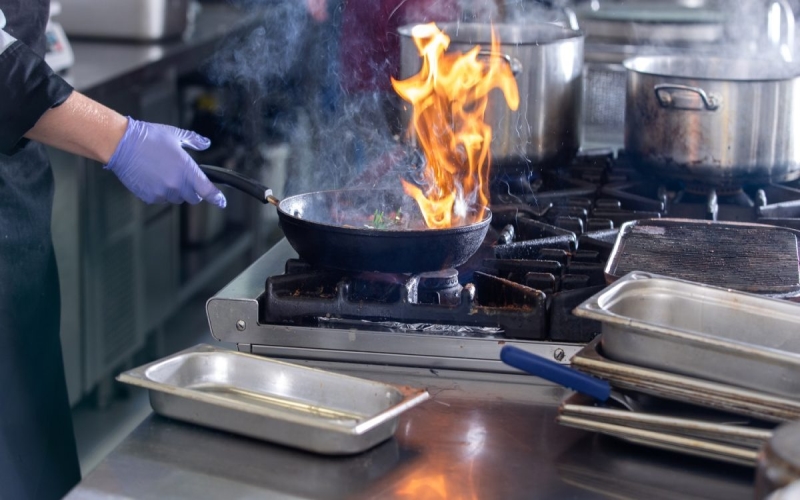
Today’s professional kitchen and restaurant equipment market is going through a period of significant technological transformation. Growing requirements for energy efficiency, and environmental friendliness, as well as the desire of restaurateurs to optimize operating costs and increase labor productivity, encourage suppliers to implement innovative solutions.
As the market grows, kitchen equipment suppliers are actively competing for consumers. A key factor in competitiveness is the ability to offer advanced products with a focus on energy efficiency, multi-functionality, use of safe materials, and reduction of negative environmental impact.
Innovative technologies
To meet the demands of today’s market, suppliers are actively adopting advanced technological solutions. The main innovation trends are intelligent systems, multifunctionality, and the use of new materials.
Intelligent control systems
Increasingly, equipment is equipped with built-in sensors, computer systems, and special software. This allows continuous monitoring of operating modes, and automatic adjustments to optimize cooking processes and save resources.
Multifunctionality
Combining different functions in one device is becoming an important trend. Steamers combine the functions of ovens and steamers. Grills combine the functions of fryers and smokers. This saves space in the kitchen.
New materials and coatings
The use of innovative materials, high thermal conductivity ceramics, and nano-coatings improves the performance, energy efficiency, and durability of equipment, reducing operating costs for establishments.
The use of innovative technologies ensures maximum product efficiency to meet the stringent requirements of the restaurant industry for resource and energy efficiency, safety, and versatility.
Energy efficiency as a key trend
Rising energy costs and the need to reduce environmental impact make energy efficiency a priority for equipment.
Heat recovery systems
Many companies equip their products with heat recovery and utilization systems. Ovens and combi steamers use the heat generated during cooking to heat air or water, saving up to 30% of energy.
Alternative energy sources
The segment of induction equipment with high energy efficiency due to electromagnetic induction is actively developing. Induction stoves consume 30-40% less electricity.
Optimization of working cycles
“Smart” equipment analyzes and optimizes cooking cycles, automatically adjusting temperature, humidity, and other parameters, preventing overconsumption of energy.
Energy-saving refrigerants
Refrigeration equipment uses environmentally friendly refrigerants with low greenhouse gas potential and high efficiency, such as carbon dioxide and propane.
Reducing energy consumption is an important development vector, saving customers substantial amounts of money and providing a competitive advantage.
Environmentally friendly production and packaging
In parallel with energy saving, more and more attention is being paid to minimizing the negative environmental impact at all stages of production and packaging.
Use of eco-materials
Recycled raw materials, recycled plastics, and recyclable materials are used. This reduces the amount of non-recyclable waste.
Minimizing the use of plastic
The industry has set a course to reduce the use of plastic in packaging in favor of paper containers and biodegradable packaging made from sustainable plant-based materials, which will significantly reduce the burden on the environment.
Waste-free production
Much attention is paid to the conversion of production cycles to the principles of zero-waste and closed-loop production. Waste is sorted, recycled, and reused.
Cleaning of emissions
Work is underway to maximize the purification of emissions and effluents from harmful substances by installing high-efficiency filters.
Renewable sources
More and more production facilities are being converted to renewable sources — solar panels, wind turbines, and biomass energy to neutralize the carbon footprint.
Sustainability is becoming an integral part of the policies of leading suppliers. Consumers are favoring products with a full life cycle according to new standards.
Industry outlook
Industry experts forecast further digital transformation of supply: automation, the Internet of things, data analytics, cloud technologies, and the application of AI:
- Demand for personalized, modular equipment tailored to specific customer needs is expected to grow.
- Regulations on energy efficiency, plastic regulation, and emission control will continue to tighten.
- Environmental awareness among consumers will increase. Facilities using green technologies will be more attractive.
- Innovative materials and advanced technologies will continue to be developed to maximize productivity while minimizing resources.
Energy efficiency, sustainability, digitalization, and personalization of offerings will be key development vectors. Suppliers aligned with these trends will gain significant competitive advantages.
Customer focus
In a highly competitive and ever-changing market, the ability to maximize customer satisfaction and expectations is a key success factor.
Restaurant equipment suppliers are paying more and more attention to studying the real needs of restaurateurs and finding innovative solutions that fully meet these needs.
Feedback and close cooperation
Companies strive to build strong partnerships with customers based on trust and understanding of their business specifics. Surveys, face-to-face meetings, focus groups, and equipment testing are regularly conducted in real restaurant and kitchen environments.
This allows for detailed feedback, and a better understanding of the pains, challenges, and actual needs of customers.
Flexible, modular, and personalized solutions
Based on the collected information and wishes, flexible solutions are developed with wide possibilities of customization and adaptation to the specific requirements of the establishment.
The role of modular designs is increasing, allowing the combination and grouping of different functions within a single system, creating a unique configuration for each customer. The range of design options for integration into any stylistic concept is expanding.
Service, support, and partnership development
Great importance is attached to quality comprehensive service at all stages of cooperation — from pre-sales consultation and assistance in selection to technical support, installation, adjustment, and regular maintenance of equipment.
We offer loyalty programs, extended warranties, and customer training. Information events and master classes are organized to develop partnerships and share experiences.
Thus, close customer-oriented work based on constant dialog and feedback, the flexibility of the offered solutions, as well as comprehensive service support become the key factors in winning the loyalty and trust of customers. And the key to the success of suppliers in a highly competitive environment.
Conclusion
The professional kitchen and restaurant equipment market is going through a period of major transformation. Suppliers need to adapt to new realities and requirements to remain competitive.
Energy efficiency, eco-friendly products, digitalization, and a customer-centric approach are becoming key success factors. Companies that can keep up with these starwikitalk trends will have a significant advantage in the market.
Flexibility, innovation, and a willingness to change will define industry leaders in the coming years. Vendors will have to rethink their approaches to developing solutions and interacting with customers to meet the new standards.
Timely transformation of business processes to meet current requirements will be the key to sustainability and commercial success in this highly competitive industry.