

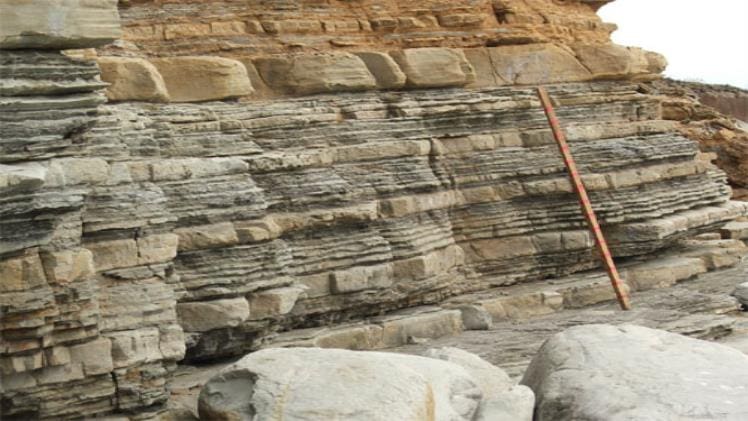
Turbidites are sedimentary rocks that form when sediment is transported and deposited by turbidity currents. These currents occur when water from a lake or ocean is disturbed, causing it to flow rapidly and carry sediment with it. Turbidites can be found in many different locations, including oceans, lakes, and riverbeds. Identifying turbidites can be difficult, as they look similar to other sedimentary rocks. However, there are some characteristics that can help you differentiate between turbidites and other sedimentary rocks.
Identifying Turbidites
Turbidites can be identified by looking for certain characteristics. Some of the most common characteristics of turbidites include their layered structure, the presence of graded bedding, and the presence of rip-up clasts.
The layered structure of turbidites is one of the most noticeable characteristics. This structure is formed as the sediment is deposited in layers due to the force of the turbidity current. The layers can be seen in the rock and can vary in thickness.
The presence of graded bedding is another characteristic of turbidites. Graded bedding is when the particles in the sediment are sorted by size. This occurs as the sediment is transported by the turbidity current and the larger particles settle to the bottom while the smaller particles remain in suspension.
The presence of rip-up clasts is also a characteristic of turbidites. Rip-up clasts are pieces of sediment or rock that have been ripped up by the turbidity current and deposited in the sediment. These clasts can be seen in the rock and can help to identify turbidites.
Turbidite Characteristics
Turbidites have several characteristics that can help to identify them. These characteristics include their layered structure, the presence of graded bedding, and the presence of rip-up clasts. In addition, turbidites can also have other characteristics such as a high content of clay minerals, a high content of organic material, and a high content of carbonates. By looking for these characteristics, it is possible to identify turbidites.
In conclusion, turbidites can be identified by looking for certain characteristics, such as their layered structure, the presence of graded bedding, and the presence of rip-up clasts. By looking for these characteristics, it is possible to easily differentiate between turbidites and other sedimentary rocks.