

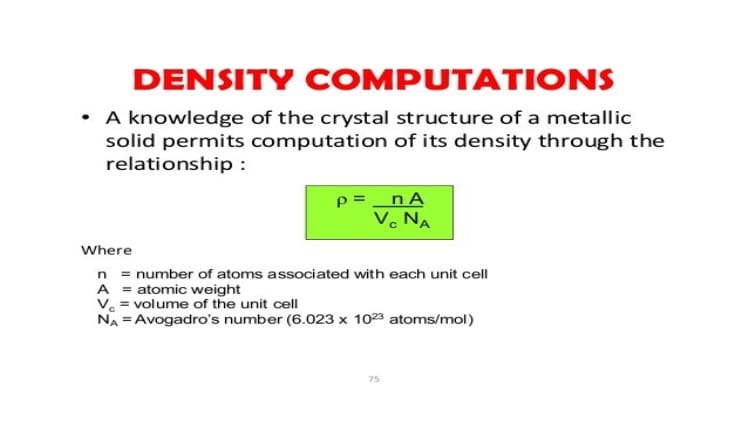
Density is a key physical property of any material and is an important factor in various industries and applications. Density can be calculated from a number of different factors, including the mass and volume of the material. In this article, we will discuss the formula for density in the solid state and how it can be applied to materials in this state.
Calculating Density
The formula for density is defined as the mass of an object divided by its volume. This can be expressed mathematically as follows:
Density (ρ) = Mass (m) / Volume (V)
Therefore, if the mass and volume of a material are known, the density can be calculated by using this formula.
Applying to Solid State
When applying the formula for density to solid state materials, it is important to note that the volume of the material is not always the same as the volume of the object. This is because the object may have an irregular shape, and the volume of the material will be affected by its shape. Therefore, it is necessary to measure the volume of the material accurately in order to calculate its density.
Once the volume of the material has been determined, the density can be calculated by dividing the mass of the material by its volume. This will give an accurate measure of the density of the material in its solid state.
In conclusion, the formula for density in the solid state is a useful tool for determining the physical properties of materials in this state. By accurately measuring the mass and volume of the material, the density can be calculated and used to compare materials or for other applications.