

The Himalayas are one of the most awe-inspiring mountain ranges in the world. They are a source of great beauty, mystery, and wonder. But when did they form? During which epoch did the Himalayan Mountains form? To answer this question, one must understand the geological history of the Himalayas.
Formation of the Himalayas
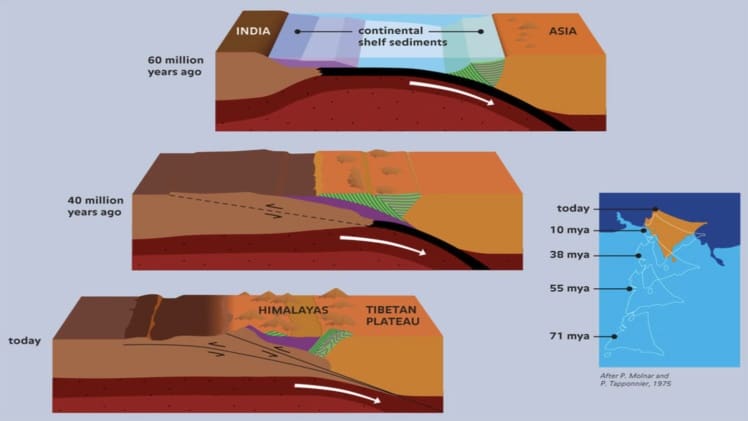
The Himalayas were formed by the collision of two tectonic plates – the Indian Plate and the Eurasian Plate. This collision is believed to have occurred around 50 million years ago in the late Eocene epoch. The tectonic plates collided, pushing the Indian Plate up and over the Eurasian Plate. This collision caused the Indian Plate to thrust up and form what is now known as the Himalayan mountain range.
The Himalayas are still growing, and the collision of the two tectonic plates is still ongoing. The mountains are still rising at a rate of about 5 millimeters per year, and the Himalayas are now the highest mountain range in the world.
Geological Significance of the Himalayas
The Himalayas are a significant geological feature for a number of reasons. First, they are a source of great biodiversity, with over 300 species of birds and over 100 species of mammals living in the region.
The Himalayas also play an important role in climate change. The mountains act as a barrier to the monsoon winds that bring moisture from the Indian Ocean to the region. This moisture is essential for the region’s agriculture and the survival of its people.
Finally, the Himalayas are a source of great geological knowledge. The mountains are a natural laboratory for geologists and other scientists to study the tectonic forces that formed them and the ongoing process of their formation.
In conclusion, the Himalayas were formed during the late Eocene epoch, around 50 million years ago. The mountains are still growing, and the collision of the two tectonic plates is still ongoing. The Himalayas are a significant geological feature, providing a source of great biodiversity, playing an important role in climate change, and offering a natural laboratory for geologists to study the ongoing process of their formation.