

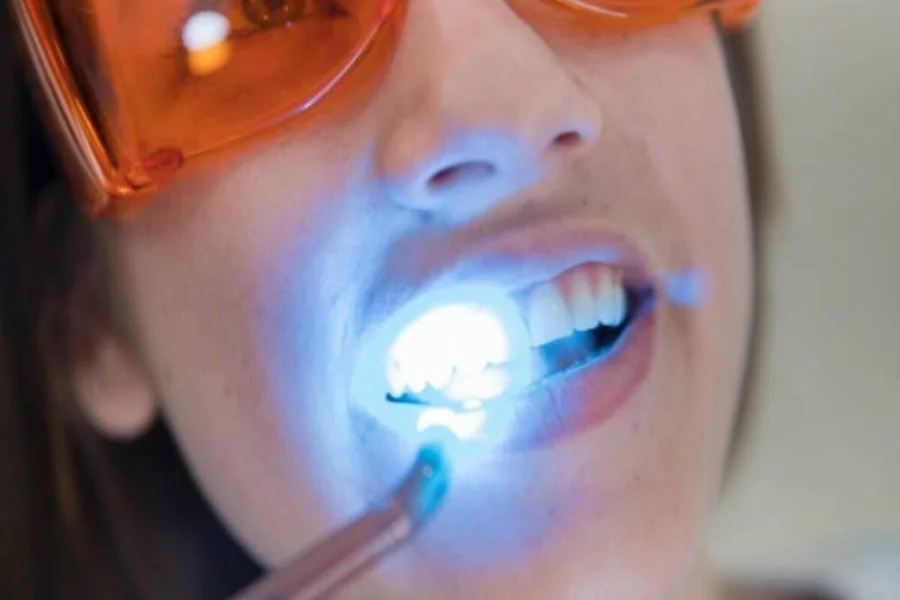
Whitening is the most requested cosmetic dental treatment among international patients visiting Turkey, and it plays two quite different roles. For some patients it is the entire reason for the appointment. For many more it is the opening move in a larger smile makeover, and getting the sequence right matters more than most people realise. The treatment itself takes 60 to 90 minutes, needs no anaesthetic, and produces in one session what home products take weeks to approximate. Add Antalya’s direct flight connections from the UK and Europe and whitening becomes a practical day treatment alongside broader dental work.
How Laser Whitening Works
A hydrogen peroxide or carbamide peroxide gel is applied directly to the tooth surfaces. A high-intensity laser or LED light is then directed at the teeth, accelerating the bleaching reaction and allowing the process to reach a depth that at-home products cannot, since retail kits must use lower gel concentrations for safety without supervision. A typical session involves three or four rounds of gel application and light activation. A desensitising agent is usually applied at the end to reduce post-treatment sensitivity.
Clinic vs Home: What Actually Differs
| Factor | In-Clinic Laser Whitening | At-Home Whitening Kits |
| Treatment time | 60–90 minutes | 2–4 weeks |
| Gel concentration | Professional strength (25–40% HP) | Lower concentration (10–15% CP) |
| Result depth | Multiple shades in one session | Gradual lightening |
| Cost in Turkey | €150 – €250 | €30 – €80 for kit |
| Cost in UK private | £300 – £700 | £80 – £300 for custom trays |
| Longevity | 12–24 months | 6–12 months |
2026 Price Comparison
| Country / Region | Average Cost | Notes |
| UK (private in-clinic) | £300 – £700 | Brands such as Zoom, Enlighten, or Pola; significant variation between clinics |
| Germany | €250 – €600 | Not covered by statutory dental insurance |
| Antalya, Turkey (Dental Harmony Turkey) | €150 – €250 | Single in-clinic session; comparable results to UK equivalent brands |
The saving against UK private treatment sits consistently around 50 to 60%. For patients already in Antalya for other work, adding a whitening session costs very little additional time and almost nothing in additional travel.
The Sequencing Rule That Cannot Be Broken
This is the single most important clinical point for anyone combining whitening with ceramic work, and it is where uninformed patients most often end up with a result they dislike.
Natural enamel responds to bleaching. Ceramic does not. If crowns or veneers are fitted first and the natural teeth are whitened afterwards, the restorations will remain at their original shade while everything around them lightens, leaving them conspicuously darker. There is no correction for this short of remaking the restorations.
For that reason Dental Harmony Turkey always schedules whitening before any crown or veneer treatment. Patients planning E-max crowns in Antalya alongside whitening have their ceramic shade finalised only after the whitening session is complete, so the restoration is matched to the brightened natural teeth rather than to the shade they arrived with.
During and After the Session
In the chair. A gum barrier, either a rubber dam or a liquid resin, protects the soft tissue. The gel is applied in multiple rounds, each activated for roughly 15 minutes. Total chair time runs 60 to 90 minutes.
The first few hours. Some patients notice a chalky, very white appearance immediately afterwards. This is normal dehydration of the enamel and resolves over 24 to 48 hours as the teeth rehydrate and the shade settles to its true final level. Do not judge the result on day one.
Sensitivity. Mild to moderate sensitivity, particularly to cold, is common for 24 to 48 hours and is temporary. Using a desensitising toothpaste in the days before and after the appointment reduces it noticeably.
Maintenance. Avoid heavily pigmented food and drink — coffee, red wine, berries, curry, dark sauces — for 48 hours while the enamel rehydrates. Longer term, occasional at-home touch-up trays extend the result across the 12 to 24 month window.
Who Responds Well, and Who Does Not
1.Yellow or brown surface staining from food, drink, or tobacco responds best of all
2. Age-related darkening, which affects everyone gradually, reverses effectively
3. Grey and tetracycline-stained teeth respond partially at best; expectations should be set accordingly
4. Active decay, untreated gum disease, cracked teeth, or highly sensitive enamel rule the treatment out until resolved
5. Existing crowns, veneers, and composite bonding will not change shade at all
Is It Safe?
Performed by a qualified clinician with correctly calibrated equipment, laser whitening is safe and well tolerated. The genuine risks come from overuse and from treating teeth with untreated decay or existing sensitivity, which is exactly what a professional assessment beforehand is for. Unsupervised retail kits carry a higher risk of gum irritation and uneven results, largely because non-customised trays let gel sit where it should not and because application is inconsistent between sessions.
Final Thoughts
At €150 to €250 in Antalya against £300 to £700 in the UK, whitening is one of the least complicated cost comparisons in dental tourism — no material trade-offs, no two-visit structure, no long-term maintenance commitment. For patients already travelling for larger treatment, it is efficient use of both clinic time and travel investment, provided it happens first in the sequence. Visit Dental Harmony Turkey for details on Dental Treatment in Antalya and to confirm scheduling alongside other planned work.